Tuesday, 14 March 2017

City of Thorns by Ben Rawlence: Book Note

City Of Thorns by Ben Rawlence: Book Note

Last week (March 2017) I read Ben Rawlence’s City of Thorns: Nine Lives in the World’s Largest Refugee Camp (published in 2016 by Random House Canada).  Rawlence is a journalist and former researcher for Human Rights Watch. In this book, he focuses on nine (pseudonymous) people who live in the Dabaad refugee camp in eastern Kenya, close to the Somali border. About a half-million people live in the camp, which is in reality a huge city. Most residents are ethnic Somalis from Somalia, but others are refugees from Sudan and Ethiopia. Some, indeed, are Kenyans who live in the camp and register illegally as refugees in order to have access to free food. 

This doesn’t seem like a camp full of refugees in the usual sense, since many who live there cross back and forth to Somalia, the country they ostensibly fled. Maryam travels from Mogadishu to Dabaad to marry Guled, who has fled the terrorist Al-Shabaad group that had forcibly recruited him. Her mother comes with her, but later returns to Mogadishu and persuades Maryam to return there as well. They would rather live in a house with adequate food, even at the risk of being bombed, than live in a tent in Dabaad, reliant on rations that are often cut. In any event terrorists, presumably al-Shabaad, start attacking the camp itself, so one way or another, they face the threat of bombs. Meantime international aid personnel live in walled compounds.

Ben Rawlence
The camp is also are rife with what we might call corruption, but in practice is normal business. While the World Food Program (WFP) distributes rations on a strictly equitable basis, food is bought and sold. Even starving people sometimes sell their rations so that they can acquire enough funds to make a phone call home. Food destined for the camp is sold en route, and food distributed in the camp leaves it for Somalia. Some people amass fortunes while others starve.  The Kenyan police who are supposed to maintain order can be bribed and bought. An honest Kenyan police supervisor is quickly dismissed, perhaps because the corruption reaches to the very top of the Kenyan political structure. Some WFP food even ends up in the hands of Al-Shabaad, the terrorist Islamist group whom the Somalis are ostensible fleeing.
Dabaad refugee camp

One reason for the corruption is that refugees are not permitted to work in the camp or outside it, as scarce jobs are reserved for Kenyans. Expatriate personnel are, however, permitted to offer refugees “incentive jobs” where they can work and learn skills at a tenth or less than other people are paid for the same job. There is fierce competition for these incentive jobs, as even the tiny amounts the refugees can earn put them at a distinct advantage over those who simply languish in tents, waiting for food handouts.

Meantime the camp is rife with all the problems that any other city faces, including racism. Muna, a young Somali woman, falls in love with Monday, an older Sudanese man. They marry, but they cannot live in a Somali area of the camp because the Somalis as horrified that Muna has married a black man. They retreat to the Sudanese area where they are guarded night and day by Monday’s compatriots. When Muna gives birth, she has to be transferred to a hospital outside the camp because Somali nurses in the camp hospital have threatened to kill her child as soon as it is born.

Other Somali women and girls in the camp are still subject to the control of their male kin. The foreign aid workers offer numerous lessons on gender balance and other liberal norms of the Western world, but women who accept these norms are often considered to be outcasts. They are still expected to marry: relatives arrange their marriages to men who may be in the camp but may still be in Somalia. Dabaad camp is, in effect, merely an extension of Somalia itself.

Sadly, just as I finished reading this book the media started publicizing another famine in Northern Kenya, Somalia, and South Sudan. As usual, the WFP and other organizations began to appeal for funds.  After reading City of Thorns, I wondered briefly what the point was of donating money. Would my donation actual reach the people who were starving, or would it merely enrich a businessman in a refugee camp? Worse, would it end up in the hands of Al-Shabaad or one of the unbelievably cruel and cynical warlords now wreaking havoc in South Sudan?  If so, my donation might be used to buy weapons and kill the many people I would like to feed. 

Books like Rawlence’s run the risk of creating isolationists, people who wash their hands of conflicts in faraway places. What is the point of trying to help if so many people profit from the funds that we donate? I decided to make my usual financial contribution nevertheless, hoping that some of it might help to feed a few people somewhere.


Thursday, 2 March 2017

Malnutrition Confirmed in Venezuela

Malnutrition Confirmed in Venezuela

Recently my former research assistant on Venezuela, Antulio Rosales, forwarded me a report by Anabella Abadi in an English-language website called Caracas Chronicles. The report is called “Caritas Study finds Childhood Hunger Racing to Crisis Levels,” and it summarizes the finding of the Catholic organization, Caritas Venezuela, which surveyed children in several of the poorest regions of Venezuela. You can find Abadi’s article here.


The gist of this report is that in Venezuela, once the richest country in Latin America, childhood malnutrition in some of the poorest areas of the country has now reached levels of what is called GAM, global acute malnutrition. When ten per cent of kids are malnourished, a region is at the serious level; when fifteen per cent are malnourished, it’s at the critical level. In twenty-five of the poorest parishes that Caritas surveyed, GAM was at 8.9 per cent between October and December 2016. Many of these parishes are isolated, with poor access to public services and high rates of poverty.

I have been following Venezuela for several years, and have posted blogs on the situation there on several occasions. You can access them here:

I’ve also written an article in Human Rights Quarterly (volume 37, no.4, 2015, pp. 1024-45) on Venezuela, which you can access on-line or email me for a copy at hassmann@wlu.ca. And I’ve discussed Venezuela in my recent book, State Food Crimes (Cambridge University Press, 2016). 

At the time I sent my book to the press in October 2015, I had read one report about malnutrition and was worried about what might happen: now I know that it is quite widespread.

Nicolas Maduro
Conveniently, the government of Venezuela no longer releases statistics that could damage its international reputation. According to Abadi’s article, the last time the government released data on childhood malnutrition was in 2007, just at the time that food shortages started. UN data is out of date. And it’s even more worrisome that the Food and Agriculture Organization gave President Nicolás Maduro an award in 2013 for reducing malnutrition, when there was already plenty of evidence of food shortages. Maduro became President in 2013 after Hugo Chávez, the President whose policies started the food crisis, died. 


As Abadi’s article said, the problem is not the low price of oil (which is often reported as the cause of food shortages, at least on CBC radio). And it’s not because of weather events. It’s because of incompetence, corruption, and an evolving dictatorship. For over a decade now the government has controlled the price of food; these prices are so low that many food producers and distributors have gone out of business. The government has also expropriated productive ranches and farms. I personally know a Venezuelan refugee here in Canada whose family’s ranch was expropriated, and now nothing is produced on it at all.

Food is rationed with guards standing outside supermarkets; people have to show their ID to get in and can only shop on certain days of the week.  Sometimes they have to be willing to give biometric information as well. People line up for hours, sometimes for days, hoping to find food. There isn’t enough milk for babies. 

More and more people are moving to other countries to find food. There’s also a thriving smuggling industry where Venezuelans buy food at low prices in Venezuela itself, sell it across the border to Colombia where the price is raised, then other Venezuelans travel to Colombia to buy it back.

Corruption eats up enormous amounts of food, whose distribution is controlled by the military.  Exporters to Venezuela have to pay huge bribes; so do importers, truckers, buyers, local vendors, and everyone else in the supply chain. If you don’t pay the bribes, food is left to rot in plain sight of starving citizens. You can see a detailed article about this corruption here:


According to Abadi’s article, recently a high school student confronted President Maduro to complain that the lunch program at her school had been cancelled. In a show of supreme indifference, Maduro replied by asking her what she personally was doing to solve the food crisis, saying (according to Antulio’s translation) “You cannot just make a request, you have to mobilize, go to the streets so that your word is heard.”  Maduro’s comment is ironic, given that the government has become increasingly repressive, jailing and torturing political opponents.

One of the problems here is that the international community can do so little to help Venezuelans. There’s no international law that says a country’s rulers can’t mess up the economy if they want to. There’s no option of humanitarian intervention. Maduro and his clique don’t care at all about international human rights law. The best option to pressure them is through the Organization of American States and other Latin American organizations, but so far that hasn’t stopped or even modified the corruption around food distribution. 

Malnutrition in Venezuela is entirely avoidable. A brutal, callous, stupid and corrupt leader supported by equally awful advisors caused it and perpetuates it. I don’t know whether Maduro is personally making money from oil revenues and food rations, but a lot of other people are. At best, he is an ignorant thug.


Wednesday, 22 February 2017

Rightlessness in an Age of Rights: Book Note

Rightlessness in an Age of Rights: Hannah Arendt and the Contemporary Struggles of Migrants, by Ayten Gündoğlu: Book Note

(Note: I wrote this book review for Human Rights Quarterly: I am posting it with the permission of the editor, Bert Lockwood; the publication information is New York: Oxford University Press, 2015)

In The Origins of Totalitarianism, Hannah Arendt famously called for the “right to have rights.” Reflecting on her own status as a stateless refugee from Germany, Arendt broadened her analysis to include the problem of statelessness as a whole. Ayten Gündoğdu engages with the entirety of Arendt’s opus, especially with The Human Condition and On Revolution as well as with The Origins, to unpack the various meanings and implications of this call.

Gündoğdu starts with what Arendt called the “perplexity” of the contradiction between state sovereignty and the universal enjoyment of human rights. Then and now, rights are protected--or not--by sovereign states that normally extend their protection only to their citizens, and perhaps non-citizens legally in their territory. The naked human being, unmoored from the state-people-territory framework, has no rights.

Gündoğdu extends Arendt’s argument to cover all migrants, not only stateless people, focusing on their powerlessness and dehumanization. She grounds her analysis empirically in the dehumanization experienced by residents of camps for refugees and displaced people. She also refers to the appalling detention camps now dotting the world’s island geography, where potential refugee claimants live in endless limbo.

Hannah Arendt
Gündoğdu discusses the ways in which human beings actually manufacture, claim, and win human rights. She notes that Arendt criticized the “urge to approach social issues with a moralistic framework centered on compassion,” positioning those who faced injustice as “victims…erasing their singularity and denying them equal standing.”(p. 57) Gündoğdu analyzes the limits of compassion in the treatment of camp-dwellers, people without political agency who are mere objects to be administered. She is correct that compassion is not the best basis for solidarity. Camp dwellers cannot rely on compassion if they are to be treated as equal human beings enjoying liberty. Compassion and charity leave the human being at the mercy of others, mostly those of higher status who cannot help but look down upon those who are their administrative objects.

Nevertheless, the real problem here is not that residents of refugee camps must rely on the compassion of those who administer them. Such administrators are probably well aware of the problems of subjecting residents to charity, but they are limited in what they can do by financial constraints and the state system. The UNHRC, other agencies of the UN system such as UNICEF, and non-governmental organizations such as Médecins sans Frontières are dependent upon voluntary financial contributions from states and compassionate private citizens. These voluntary contributions rarely, if ever, reach the amount needed merely to ensure that residents are not riddled by disease or suffering from malnutrition.

Gündoğdu defends Arendt against charges of élitism made by other philosophers with whose work she engages. Arendt is criticized for denigrating manual and other kinds of labor, but Gündoğdu argues that she views both labor and work as crucial to human dignity. According to Gündoğdu, Arendt defined labor as day-to-day bodily maintenance and maintenance of one’s home and surroundings. This labor grounds the individual in the material world and provides her with a sense of routine, permanence, and community with others. By work, Arendt apparently meant creativity, the ability to make or build something new and worthwhile. Both labor and work are denied to residents of camps. Dependent for their every need on the compassion of others, they endure lives of complete boredom without social roles or responsibilities. This is a degraded form of “life,” without meaning or substance.

Gündoğdu argues that Arendt did not rely on what philosophers call foundational principles of human rights. Rather, Arendt used an approach that Gündoğdu calls “founding.” Rights, she argues along with Arendt, are founded in political action, including “inaugural speech acts that bring forth new rights,” such as the French and American revolutionary documents (p. 209). To show how founding still applies, Gündoğdu describes the political movement of sans-papiers (people without papers) in France in the 1990s. Deliberately referencing the urban sans-culottes of the 1789 Revolution, this late twentieth-century movement demanded the same rights as citizens of France, claiming “rights that they [were] not yet authorized to claim” (p. 189).

Gündoğdu discusses the 18th century foundational principle for human rights, what Ētienne Balibar calls “equaliberty” (p. 23). This conjoining of the principles of equality and liberty is not enough, however, to ensure the rights of twenty-first century migrants. Indeed, it is not enough to ensure the rights of anyone, including citizens of rights-protective democratic states. Even if citizens enjoy formal legal and political equality and the liberty to pursue their own interests, they may not be able to enjoy all their other human rights, especially their economic and social rights. Enjoyment of these rights requires a sense of community among all citizens and a state that engages in distributive and redistributive measures that ensure everyone’s access to a basic minimum of material security, as well as access to educational and cultural resources that permit all citizens to be efficacious members of their own political community.       

How to extend this sense of community to strangers is a difficult question, however. Such extension requires recognition of “others” as human beings, whatever their differences.  But such recognition does not mean that these others will be welcomed as full citizens into states that are otherwise democratic and rights-protective. Probably all Gündoğdu’s readers will agree with her principal concerns, that migrants should have human rights, that they should not have to rely on charity or compassion, and that they should be permitted to engage in political action and organization, whether within the camps to which they are confined or in the countries in which they enjoy no or precarious residency rights. These principles, however, confront limited material resources and limited integrational capacities, even in states that welcome (carefully-controlled numbers of ) refugees and immigrants. And they confront everywhere racist and nativist reactions against perceived foreigners. Sadly, the right to belong to humanity does not yet mean the right to citizenship.

While Gündoğdu’s reading of Arendt and other philosophers is profound and her arguments persuasive, her book ignores some legal and political realities. From the point of view of actual law and politics, her conflation of different types of people who no longer live in their homeland is confusing.

Of the 232 million people that the United Nations tells us are people living outside the countries of their birth, some are legal migrants in or naturalized citizens of their new countries: for example, about twenty per cent of Canada’s 36 million residents are foreign-born, among whom most are legal residents and a substantial number are citizens. Figures differentiating naturalized citizens, legal migrants, migrants without legal status, refugees, refugee claimants, and stateless people would have served Gündoğdu’s analysis well. There are only about 12 million stateless people, the paradigmatic group with which her analysis is concerned. While this is 12 million people too many, it is also a far cry from 232 million people. While many migrants are de facto stateless, as Gündoğlu observes (p.4), many others continue to enjoy the legal protections of their natal states as well as of the states to which they move. Not all migrants are seen as “undeserving intruders” (p. 123): this is particularly so in the current round of globalization in which many high-status, highly-educated and wealthy people move easily across borders. Moreover, the book’s title suggests that Gündoğdu confines herself to migrants, but her analysis of the camps applies as much to those containing technically non-migrant, internally displaced people as to camps where migrants or refugees live.

Arendt may have used the philosophical term, “perplexity” to describe the plight of the naked human being without the protection of a state, but to a political scientist there is nothing perplexing about the contradiction between state sovereignty and human rights. The states that drafted the International Bill of Human Rights were anxious to maintain their sovereignty: just as anxious, if not more so, are the new states formed from ex-colonies since the end of the Second World War. Thus, while the Universal Declaration of Human Rights proclaims everyone’s right to seek asylum, no one has a right to asylum itself, as Gündoğdu notes: indeed, while everyone has the right to re-enter her own country, no one has the right to enter any other country. What commentators such as Gündoğdu call a crisis of statelessness (p. 35) is not a crisis for actual states, whose governors take for granted that they have no legal obligations to non-citizens who are not resident in their territories.

Nor will political scientists find Gündoğdu’s argument for basing human rights in human action—the “founding” of human rights—rather than in foundational philosophical principles particularly enlightening. That human rights are what human beings claim ought to be their rights is well known. Human rights are bound up in struggle, as Gündoğdu acknowledges.  Rights claims change, as do the rights that (some) states grant, as new social groups enter the rights discourse and new aspects of human dignity such as respect for sexual orientation and gender identity are made.

Despite these criticisms, this is a very interesting book well worth reading. While it will be of principal interest to political philosophers, especially those engaged with Arendt’s work, others will also benefit from Gündoğdu’s discussion of the entirety of Arendt’s thought and how it applies to migrants and camp-dwellers of all kinds. Gündoğdu is a brilliant analyst, whose thinking is informed throughout by great empathy and by the very compassion that she herself criticizes. 


Monday, 30 January 2017

Stop Appeasing Trump Now!


Stop Appeasing Trump Now!

All democrats everywhere, political leaders and ordinary citizens, must stop appeasing Donald Trump now.  They must condemn his racist policies as strongly as they can. They must stop pretending that he is a normal, democratically elected leader. They must stop being diplomatic.

When we think of appeasement, we think of Neville Chamberlain going to Munich in 1938 to sign an agreement with Adolf Hitler and returning to Britain, saying, “peace in our time.”

But the appeasement of Hitler started in 1933. Politicians and diplomats in the democratic Western world treated him like a normal political leader. They ignored his persecution of communists, socialists, trade unionists, liberals and Jews. Many people in Britain, the United States, and Canada even thought he had a point about communists and Jews.

It’s not sensible to make public policy decisions purely by analogy to past events. There’s also the old joke that the first person to invoke the name of Hitler in a political argument loses. But we can’t help thinking about Hitler now.

Since January 20 Trump has been decreeing arbitrary measures as if he has dictatorial powers.  At best, he is behaving like a mad king; at worst, he is what he seems to be, a racist and an Islamophobe.

People thought Hitler was mad too but that he could be controlled, and they were wrong. We can’t assume that Democrats will resume control of the Congress or Senate in 2018; we can’t assume Trump will be defeated in 2020; we can’t assume his successor in 2024 will be any more liberal than he is. We must join American democrats now to defeat Trump.

Premier Philippe Couillard of Quebec
Meantime here in Canada we see the effects of Islamophobic talk, as Premier Couillard of Quebec has pointed out. Words have meanings, words can hurt, and words can result in vicious actions such as the mass murder in a mosque on January 29 in Quebec City.

 The debate on “Quebec values” that the Parti Québecois unleashed in Quebec in 2013 legitimized prejudices against Muslims. In the guise of women’s rights and protection of a secular Quebec, the PQ suggested that Muslim citizens were less valuable than other citizens.  Even though the PQ was defeated in the election a year later, the damage was done. (see my article on the Quebec Values Debate posted on December 8, 2016).

When I think about Muslims today I think of my own family. My German grandparents escaped to Norway in 1938, from where they tried to enter the US. The American official in Oslo told them that my grandmother could enter as she was a Christian, but my grandfather could not as he was a Jew. Meantime one of my father’s Jewish cousins and her five-year-old daughter were denied entry into Canada: they died in the Holocaust.

I mention these personal stories because every Muslim and non-Muslim individual denied entrance to the US in the last few days has a personal story. So does every Muslim killed and wounded on January 29 in Quebec City. They all have names; they all have families; and many have suffered in ways that those of us who live in Canada will never experience. Instead of escaping from persecution, they now face more.

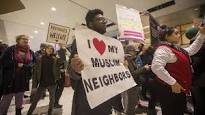
We must not appease those who would deny these Muslims their humanity. We must join with the Americans demonstrating in the streets and at airports. The US is a nation in danger of being taken over by fascists, if democrats world-wide appease the Trump dictatorship.

American pro-Muslim airport demonstration

Note:(January 30, 2017) this post has been accepted as an op-ed piece in the Hamilton (Canada) Spectator and should be appearing in the next few days.


Tuesday, 10 January 2017

The Little Red Chairs by Edna O'Brien: Book Note

The Little Red Chairs by Edna O’Brien: Book Note
Edna O’Brien has written many novels about Irish girls and young women, most of which I’ve read over the years. This novel is very different, being very political. The reference in the title is to the 11,541 red chairs--including 643 chairs for children--set up in Sarajevo in 2012 to commemorate the siege of Sarajevo by Serbian forces during the ex-Yugoslavia wars.  2012 was the 20th anniversary of the siege.

 In Part I, a foreigner called Vladimir Dragan arrives in an improbably innocent Irish village, setting himself up as a “healer” and mesmerizing people with his charm, knowledge and exoticism. Fidelma, a beautiful 40-year-old who has endured two miscarriages, falls in love with him and begs him to impregnate her, which he does. Vlad is later exposed as a Serbian war criminal by the younger brother of one of his victims, who happens to be working in a nearby hotel. Vlad is arrested, while Fidelma is kidnapped and raped with a crowbar by his erstwhile enemies, killing her “Serbian” child.

In Part II, Fidelma goes to London, where she lives a poverty-stricken life that puts her in touch with refugees, rape victims, illegal immigrants, and various other people living an underground life. Along the way there are several set pieces in which individuals tell each other their stories of war, migration, poverty, homelessness, and misogyny. At one point Fidelma lives with an African woman who migrated to London after her husband took a second wife, and whose neighbor is a lonely little girl who is not in school because she and her father are illegal immigrants. Another woman Fidelma meets has come to London to protect her daughter from female genital mutilation.

Eventually Fidelma travels to The Hague, where Vlad is now on trial. After realizing he will never apologize to her or acknowledge his crimes, she returns to Ireland.

The character of Vlad is based on Radovan Karadzic, a psychiatrist who from 1992 to 1996 was President of Republika Skrypska, a Serbian enclave in Bosnia. After 1996 he hid in plain sight for many years within Yugoslavia, posing as an “alternative healer.” It’s thought that Serbian authorities knew where he was but protected him. He was eventually arrested and sent to the International Criminal Tribunal for Yugoslavia (ICTY) in The Hague. He was convicted on March 24, 2016 of genocide, war crimes, and crimes against humanity, and sentenced to 40 years in prison.
Vlad shows how psychologically complex mass murderers can be; he loves flowers and poetry and plays the gusle (a musical instrument that looks like a one-stringed violin). We know that many Nazis, including Nazi doctors, had similarly complex psyches, enjoying classical concerts played by Jewish prisoners after long days of mass murder. Edna O’Brien said in an interview that she found Karadzic’s “duality” as a mass murderer and a healer interesting: I just thought he was preying on vulnerable people with fake cures.

In discussion with fellow members of my book clubs, the question came up what the theme of The Little Red Chairs might have been. Perhaps it was evil. Vlad is evil’s embodiment, and Fidelma wonders if she was complicit in evil. She feels remorseful for having slept with Vlad, even though she did not know his true identity at the time. She does not tell ex-Yugoslavian refugees whom she meets in London about the rape and torture she herself endured, when they criticize her for her relationship with Vlad. When she visits him in The Hague, she expects Vlad to feel express remorse but instead he mocks her quest for “truth, justice, atonement.”

Another theme was women’s suffering, especially the suffering of the various women characters who endure miscarriage, still-born births, and various “natural” tragedies not connected to politics. In her autobiography, Country Girl, Edna O’Brien recounts her own suffering as a woman, which I describe in my blog of April 7, 2015: http://rhodahassmann.blogspot.ca/2015/04/book-note-country-girl-memoir-by-edna.html. This raises the questions of whether all women might be “sisters,” because all are vulnerable to such natural tragedies, but is this false sisterhood. Miscarriages and stillbirths, however sad, do not compare to rapes, torture, and warfare.

 I didn’t find this to be as fulfilling a novel as many other readers did. There were too many set pieces, seemingly inserted so that O’Brien could incorporate as many political themes as possible, so that the book seemed rather didactic. Too many characters are introduced but then don’t reappear. It seems as if O’Brien invented the character of Fidelma in order to tie together disparate political events and misogynist practices. In the end, O’Brien brings all her characters together for a performance of Midsummer Night’s Dream. I looked up the plot summary of this play by William Shakespeare and found it very confusing, and I could not see any analogies to characters in this novel. 

Nevertheless, professors who read this blog might want to assign The Little Red Chairs to their students.  It is a good way to introduce students to scholarship on genocide, transitional justice, and women’s rights (or lack thereof).  I discussed these topics when I presented the book recently to one of my book clubs. In the past I’ve often used memoirs or novels to introduce students to various political events, and found that to be a successful teaching method.


Thursday, 8 December 2016

Minority vs. Group Rights in Quebec

Dear Readers:  In 2016 I posted an entire academic article on minority rights in Quebec on this blog, because I got tired of waiting for formal review by an academic journal.  Since then Bert Lockwood, the editor of Human Rights Quarterly, has accepted the paper for publication in HRQ, volume 40, no. 1, February 2018.  So this is an announcement of the forthcoming publication, along with the abstract below.  Please contact me at hassmann@wlu.ca if you would like an advance copy of the article. 

Minority vs. Group Rights:  Manifestation of Religious Beliefs vs. “Quebec Values”
by Rhoda E. Howard-Hassmann

Abstract: This paper investigates the debate in the province of Quebec, Canada in 2013 over a Charter of Quebec Values introduced by the separatist ruling party, the Parti Quebecois. It relies in particular on government documents, debates in Quebec’s National Assembly, and editorials in the French press. It relates the Charter to the preceding Bouchard-Taylor Commission Report in 2008 on accommodation by public bodies of particular religious requests. The debates concerned the right to manifest one’s religion, the rights of (particularly Muslim) women, and the rights of the collectivity as opposed to the minority. Part of the debate was about Quebec’s particular policy of interculturalism, as opposed to Canada’s policy of multiculturalism. The paper concludes with a discussion of liberalism, minority rights and collective rights.

Monday, 5 December 2016

Sultan Trump: Personalist Rule in the USA

Sultan Trump: Personalist Rule in the USA

Back in 1982, when I was still specializing in African studies, a very important new book was published. Edited by Robert H. Jackson and Carl G. Rotberg, it was called Personal Rule in Black Africa: Prince, Autocrat, Prophet, Tyrant (University of California Press)

At the time, many scholars were trying to figure out why so many African countries did not become democratic after they gained their independence from colonial rule. The reason, the authors in this book argued, was that African “big men” were personalist rulers. They didn’t care about laws, political institutions, or consistency in public policy. All they did was decide on a personal basis who got what when. And often the people who got— who were given profits, land, mines, slaves, women, graft from foreign aid—were the big men themselves, their relatives and their friends.
These types of rulers engaged in what the early-20th century sociologist, Max Weber, called kadi justice. The ruler made decisions about justice on an ad hoc, individual basis: he didn’t refer to rational principles and he wasn’t concerned with consistency. This was the type of justice, Weber thought, that Muslim sultans often engaged in.

Max Weber
Kadi rulers still exist, for example in Saudi Arabia. You can go to the local prince’s house, line up for an audience (literally, a hearing) with him, and hope that he’ll be interested in your case and give you justice.  But he can just as easily brush you off or even arrest you for questioning his authority or complaining about one of his relatives or cronies.

Donald Trump is now a “big man,” the biggest in the world. His idea of justice is to dish out goodies to his family and cronies. He’s brought in some of the richest men on Wall Street to his government, even though throughout the election he derided Hillary Clinton’s alleged ties to Wall Street. He’s behaving just like the personalist rulers in Africa who smile smugly as they dispense billions of dollars in graft to their families, ethnic kinsmen, and friends. And who occasionally dole out a few dollars or privileges to the “little men” who beg them for help.

And it seems that what Trump would really like to be is a sultan. He showed that last week (end of November, 2016) when he negotiated a deal with a company called Carrier to preserve about 1,000 jobs in Indiana. The employer had been threatening to move the factory to Mexico. To save the jobs, he promised the parent company, United Technologies, about $7 million in incentives. You can read about the deal here: http://www.cbc.ca/news/world/donald-trump-carrier-workers-indiana-1.3875277  
So now Trump feels good: 1000 people and their families are grateful to him and many voters think that he is able to keep his promise to keep jobs in the USA, despite technological developments and despite globalization. Those 1,000 people, though, will probably lose their jobs fairly soon, as the other 1100 people working for Carrier in Indiana already have. Meantime, other companies have learned that if they threaten to move out of the US, they too may receive goodies from Trump in return for staying.

When Trump did this deal with Carrier he ignored precedent, he ignored consequences, and he ignored the actual policies of the US government.  He preferred crony capitalism, a characteristic of states where rich people and political leaders are cronies. He was completely oblivious to what Weber called “rational,” or rule-bound, justice. Rational justice applies to everyone and is consistent in its application.

After he negotiated this deal, Trump went on a “thank you” tour, where he once again enjoyed the adulation of the crowds that had voted for him. Sultans do this too. They periodically pick up their tents and travel with great fanfare around the country, where residents cheer them (whether they really want to or not). Like African chiefs who have “praise-singers” to accompany them when they travel, Middle Eastern sultans want praise: power is not enough for them. And God help those who don’t praise them.


And God help not only all those Americans who don’t praise Trump, but even those who do, and who will learn soon enough that having an irrational, personalist ruler means they can’t predict what the future holds for them.

Wednesday, 9 November 2016

Trump's Victory: A Revolt against Complexity?


Trump’s Victory: A Revolt against Complexity?

Like many Canadians, this morning (November 9, 2016) I woke to the shocking news that Donald Trump is to be the next President of the United States.  I am no expert on American elections, and I am waiting to find out who voted for Trump where and why. Most of the pundits I’ve listened to or read discussed disaffected white male voters lacking a college education. But such people are a relatively small part of the entire American population. To whom else did he appeal?

I think that one appeal he had was to people who want simple solutions to their problems.  “Elite”, “establishment” politicians like Hillary Clinton can’t offer them such simple solutions. 

Trump speaks slowly. He uses simple language (although according to a recent report on the CBC program As It Happens, there was a surge of searches of the Miriam-Webster dictionary for the word “stamina,” after he said Clinton lacked it).  He proposes very simple solutions to very complex problems. He repeats his key phrases ad infinitum. (And he has a reassuringly deep male voice, unlike Clinton, whose voice became higher and more strained as the campaign wore on.)

Trump presents clear explanations and enemies. China is the reason free trade deals don’t work.  Free trade deals deprive Americans of jobs. Illegal immigrants, mostly Mexican, are the reason that Americans can’t get those jobs that remain. Muslims in general cause terrorism. There’s too much crime. All these problems can be fixed by one-step solutions: end free trade, deport illegal immigrants, deny entry to Muslims, let police use stop-and-frisk tactics.

Trump implies that there are simply solutions to complex foreign-policy questions. Hillary Clinton should have known what to do about ISIS, and she didn’t (this is, of course, partly because she wasn’t Secretary of State when ISIS arose).  Trump “alone,” as he frequently said, knows what to do in the Middle East.  He isn’t interested in the Middle East’s complex history, America’s role in destabilizing the region, or the numerous political and military actors involved. Bomb the hell out of them is probably his solution.

Trump is anti-fact. This plays well with people who don’t like evidence, who like to form their opinions based on their prejudices, who don’t like to evaluate the legitimacy of the sources they watch or read.  Facts aren’t just irrelevant; they are an annoying challenge to imagined reality.  Facts are what teachers expect you to consider.

So for Trump and his fans, the “elite” isn’t the rich, including him. The elite is those who insist on complexity, who try to evaluate conflicting pieces of evidence, who refer to empirical facts rather than to prejudices. They are highly educated people.

I’ve seen the same attitude among some of my neighbours and among acquaintances at the gym where I assiduously lift weights three times a week.  I’ve been advised to read the “Clinton Chronicles” instead of mainstream media (actually, I read “elite” media such as The New Yorker and the New York Review of Books). I’ve been told that I would learn that Hillary Clinton does not even have a law degree from Yale, that the Clintons used their time in Arkansas to run drugs into that state, and that the Clinton foundation is stealing billions from Africa. I’ve learned that I should just thank these individuals for the information they offer me and carry on: there’s no use arguing.

In January 2016 I posted a blog discussing whether Trump was a fascist. You can find it here:  http://rhodahassmann.blogspot.ca/2016/01/donald-trump-and-fascism-debate.html  I think he does have some characteristics common to earlier fascist regimes, and of course to the nationalist, anti-immigrant right in the United Kingdom, France, Hungary and elsewhere today. But maybe it is not so much fascism as simplicity that is attractive to Trump’s voters. Hitler blamed Jews, modern demagogues blame foreigners like Mexicans, Muslims, and Chinese.

Trump claims he can fix Americans’ problems easily and quickly, implying that the elites he despises could do so too if they weren’t so self-interested. People want to believe him, so they do. As my local paper, the Hamilton Spectator, reminded its readers in an editorial this morning by Howard Elliott, Canada is not immune to Trump’s type of appeal. As Elliott put it, “We should be worried.” http://www.thespec.com/opinion-story/6954935-the-spectator-s-view-we-should-be-worried/

Meantime, my biggest worry is that the US will shortly have a President who denies climate change and who thinks that it’s okay for more countries to obtain nuclear weapons. His saner Republican advisors will probably persuade him that the latter isn’t a good idea, but many of them also deny climate change. Climate change is probably too complex for many Republican voters to understand, though for others, mitigation of climate change might lower their profits.

The real elite is the one Trump belongs to: the corrupt, self-interested, tax-avoiding, scofflaw capitalist class.


Thursday, 20 October 2016

The Return by Hisham Matar: Book Notes


The Return by Hisham Matar: Book Note

This week I read Hisham Matar’s The Return (Alfred A. Knopf Canada, 2016). Matar is a novelist of Libyan descent, now in his mid-40s, based in London. The Return is a memoir about his 2012 visit to Benghazi, in Eastern Libya, in the brief period between the overthrow of the dictator Muammar Qadaffi and Libya’s descent into civil war. Matar’s large extended family (he had 130 first cousins) was based in Benghazi and a smaller southern town called Ajdabiya.

Hisham Matar
The purpose of Matar’s visit was to find out what had happened to his father,Jaballa Matar, apparently a democracy activist opposed to Qadaffi. The family had left Libya for Cairo in 1979, where they thought they were safe, but in 1990 Egyptian authorities turned Jaballa over to Libya.  He was probably then incarcerated and tortured in a notorious Tripoli prison called Abu Salim. The family received a few smuggled letters from him until 1996, when the letters stopped. Jaballa was probably killed in a massacre at Abu Salim in 1996. Guards and soldiers took several hours to machine-gun over 1200 prisoners concentrated in six prison courtyards. But Hisham Matar never found out for sure what had happened to his father.

Matar provides some historical background to these events. His description of Italy’s conquest of Libya in the early decades of the twentieth century reminds me of the all the massacres—indeed genocides—by Europeans who conquered Africa. The population of Tripoli fell by one-sixth between 1911 and 1916, as the Italians especially selected “scholars, jurists, wealthy traders and bureaucrats” (p. 32) to murder, exile or imprison. They also established enormous concentration camps in which thousands of starving Libyans were kept in rags. Under Mussolini entire villages were gassed and bombed. Matar’s own grandfather was a tribal resistance leader who for some unknown reason was not assassinated by the Italians. (Matar bases his description of the Italian conquest in part on a book by a Danish journalist, Knud Holboe, who was murdered in Jordan, perhaps by Italian intelligence.)

The sadism practiced by Qadaffi’s regime is also beyond belief. Many family members were unaware until 2002 of the deaths of their husbands, sons, fathers and brothers in the 1996 prison massacre. That year officials came to their doors to ask for the “family books” in which each family officially registered birth, marriages and deaths. A few weeks after taking the books, the officials would return them, saying all was in order. Some families checked the books right away, others not till days or even weeks later. When they did, they discovered that “died of natural causes in 1996” had been written over the names of their imprisoned family members.

One mother made a twelve-hour trip every month to see her son in Abu Salim. After 1996 she never saw him again. But every month, the guards would accept the gifts of food, clothing, and soap that she had brought him, and encourage her to come the next month. Not until she examined the family book after the officials returned it in 2002 did she learn that for six years, she had been making futile trips to visit a dead man and supplying guards with goods that they could sell to surviving prisoners or keep for their own families.

Matar’s memoir is a little disingenuous. He never informs the reader of the name of his father’s oppositional “organization” based in Chad. Nor does he inform the reader of the name of the tribe he came from, based in Benghazi. Jaballa Matar was adopted by Amnesty International as a prisoner of conscience, which suggests that he was a non-violent activist for democracy. But it would have been nice to have more concrete political information so that one could follow current events in Libya more clearly.

Nevertheless, if, like me, you know hardly anything about Libya, this book is a good place to start. It exposes how truly dreadful Qaddafi’s regime was, and puts the lie to those who nostalgically remember his “orderly” society in these days of civil war. It also introduces the reader to a family of patriotic scholars, poets, engineers and diplomats, an extended cosmopolitan family still strongly rooted in Arab tradition. But this type of family—nationalistic, patriotic, but still tolerant and learned, is fast being destroyed all over the Middle East.  

Thursday, 6 October 2016

White Africans: Is There Such a Thing?


White Africans: Is There Such a Thing?

In the past few days there have been reports in the Canadian and international press about a white farming family that escaped from Zimbabwe to Canada; the father had rights to live here through his grandfather.  Danielle and Mark McKinnon and their three young children fled after various officials and private individuals claimed ownership of their farm. Three years ago, Mark MacKinnon was kidnapped and beaten. They had had enough and decided to leave.

This is just the latest in the sorry tale of expulsions of white farmers from Zimbabwe. While the official myth is that all white owners of large productive farms inherited them from the original British colonists in what was formerly Southern Rhodesia, this is untrue. A substantial proportion of the farmers bought their property legally after independence in 1980.  The government had the right of first refusal on all such sales, and if it decided not to buy, then white (and black) farmers were free to do so.

As it happens, last week I read another tale of white people in Zimbabwe, The Last Resort by Douglas Rogers (published in 2009 by Harmony Books). Rogers’ book is about his white parents, who in 1990 legally bought land near Mutare, Zimbabwe. There they established a backpackers’ resort and also built 16 small chalets for rent. This resort became quite famous and was featured in The Lonely Planet, a guide for inexpensive world travel. Until 2009 Rogers’ parents survived as owners living in their own house, mainly by ignoring what their black African tenants were using their property for; first as a brothel and then as a refuge for illegal diamond traders. I couldn’t discover what happened to them after 2009.

Douglas Rogers
This leads to the question whether white people can be considered indigenous Africans. On one side, Rogers’ ancestors had lived in Africa for 350 years. While nowadays many white Africans take advantage of their residual citizenship rights in places like Ireland, in case they are expelled, Rogers’ parents had no such rights. Nevertheless, at one point his mother was declared effectively stateless. Zimbabwean authorities refused to renew her passport unless she renounced her British and South African citizenship rights. She had no such rights, but she had to visit the South African and British consuls to obtain their certification that she didn’t.

So what does it mean to be indigenous?  We can easily agree that the people who lived in Zimbabwe or South Africa (or Canada or Australia) before Europeans arrived were indigenous to those territories.  But are people who know no other home, who were born and grew up in those countries, and whose ancestors, in many cases, arrived decades or centuries before, also to be considered indigenous? Or does skin color mark you as a permanent outsider?

The legal solution to this problem is to ignore the question of who is indigenous and focus on citizenship rights instead. If a country’s laws says you are a citizen if you are born there or are naturalized there, that should be the end of it.  But some countries allocate citizenship not on the basis of birthplace but of ancestry. You can be born in a country and your parents can be born there too, and still not be a citizen if your most immediate ancestor in that country is from somewhere else. This is the type of law that made it easy for the Nazis to render German Jews stateless in the 1930s, and still makes it difficult for German-born people whose ancestors emigrated from countries such as Turkey to become citizens. 

It seems like Zimbabwe would like to move from citizenship by birthplace to citizenship by ancestry. It’s been applying this criterion not only to white Zimbabweans but to people whose ancestors migrated from places like Malawi. Anything to get rid of people who don’t support Robert Mugabe’s thuggish regime.

The anti-white rhetoric in Zimbabwe under its aged dictator, Robert Mugabe, is outright racist.  As I document in my new book, State Food Crimes, he’s said all sorts of terrible things, stirring populist anger against white people and justifying his campaign of theft of their land. This theft  has resulted in enormous economic upheaval and shortages of food. No matter to Mugabe and his allies: they don’t care.
Robert Mugabe

Populist anger against so-called outsiders is always dangerous, whether it’s Robert Mugabe in Africa or Donald Trump in the United States. In Africa, populist anger against white Africans (and also Asian Africans, in earlier times such as in Idi Amin’s Uganda in the 1970s) has ruined national economies. If populists take power in South Africa and force their indigenous white population to flee, the same thing will happen there.

White Africans are indigenous to Africa. You can’t go on claiming that white people are outsiders because their extremely remote ancestors came from Europe. Calling people “settlers,” despite their birthplaces and despite their legal purchases of land, puts them permanently at risk. Their citizenship rights and their human rights are under constant threat, and the entire society suffers as a result.