Tuesday, 26 January 2016

Book Note: Life after Life by Kate Atkinson


Book Note: Life after Life by Kate Atkinson

Kate Atkinson’s Life after Life was widely reviewed after it was released in 2013, and has been very popular, not least among the women in the two book clubs in Hamilton, Ontario of which I am a member. I presented this book to one of my clubs on January 18, 2016.
The heroine of Life after Life, Ursula Todd, lives several different lives. Darkness descends over one life after another, and then the heroine emerges to live a new life, starting with her death the moment she is born. It’s not surprisingly, then, that one of the themes that reviewers have picked up on is the contingency of life. The novel asks what would happen if we could change history, or re-set the clock; we all wonder, sometimes, “what if” we had taken a different path, what would our lives be like.


Kate Atkinson
Ursula dies at her birth in 1910, but then she does not.  But she might well have: the infant mortality rate in the United Kingdom was 115/1000 in 1910 (compared to 250/1000 in Russia and 250/1000 in Germany). After World War I, everyone breathes a sign of relief until the Spanish flu comes along, maybe—or maybe not—killing members of her household.
In a review in The Guardian on January 12, 2014, Justin Cartwright wrote: “human life…hang[s] by a thread…our identities are not necessarily fixed.”  This raises the question, are we now the people we were at 20? At 40? How have we changed, and are the changes good or bad?  It also raises the question of whether we are mere victims of fate.  In the novel, Ursula’s psychiatrist introduces her to the phrase amor fati, or love of fate; and I have met people who say “Oh well, it was meant to be.” But I am interested in the question of whether we can influence things, not merely our own lives, but the lives of our families and those we love, and even the larger world. And I’m also interested in the question of how much obligation we have to try to influence that world.

Image result for Life after Life imageLife after Life is a political book, though reviewers seem to have neglected that aspect of it. The book opens with Ursula in Germany in 1930, assassinating Hitler. This is something we all wish someone had done: I believe that without Hitler, there would not have been genocide, though there still might have been another war. But in another life Ursula moves to Germany and becomes friendly with Eva Braun, Hitler’s mistress, whom she visits at his mountain retreat in Berchtesgaden. In this life Atkinson paints Ursula and Eva as innocents, Eva attending to Hitler’s every personal need while Ursula enjoys the view and raises her daughter. To me, this raised questions of moral culpability. Were Eva and Ursula, women without clout or power living in a man’s world, nevertheless obliged to pay attention to politics? 
In another life Ursula stays in London during the war, working as a civil servant during the day and as an air-raid warden at night. In this life we don’t have to worry about her obligation to affect the world: she is “doing her bit” as a heroic British citizen should, during the Blitz. One question raised at the book club meeting was whether Ursula actually had a core personality, moving as she did among different lives. I assumed she did, and the heroic, hard-working unmarried British woman was it.

Life after Life is also a feminist book, at least for those of us who know what life was like for most women in the Western world until the sea change of second wave feminism gave us rights after about 1970. It read, to me, like a novel about what could have happened to my Scottish mother (born in 1920) and what did happen to many women, and it shows women’s powerlessness until the last third of the twentieth century.

In one of Ursula’s lives a little friend is molested and found dead. If Ursula had been molested and lived, her parents would probably not have believed what had happened to her, unless she accused a lower-class molester, perhaps one of the traumatized veterans of WWI wandering around the country lanes, bothering Ursula’s upper middle-class parents and their friends. In another version of her life her older brother’s college friend rapes her and leaves her pregnant. A woman raped in 1926 by a “respectable” young man would have had little recourse against him. And if she’d had an abortion, she would have risked death or infertility, and disgrace and imprisonment if caught.
Nor could she have kept the baby and lived a respectable life: the stigma of being an unmarried mother with very few very few resources would have been too severe. As it happens, in October of 2015 I visited the Foundling Museum in London’s Russell Square, a museum of the first British
The Foundling Museum
home for unwed mothers set up in 1793, for otherwise “respectable” women who had somehow been seduced and traduced by various bounders and cads. The women’s employers or family members had to write reference letters to the Foundling Home promising that the mothers were otherwise respectable.

In yet another life, Ursula meets a charming man and marrieds him. Then he tries to imprison her at home, beats her, and ultimately kills her. In real life, wife-beating was considered a “domestic” matter in most of the Western world up until the 1970s, or even beyond.
In her German incarnation, Ursula is also affected by the inferior status of women. When WWII starts she wants to go back to England with her German-born daughter, but she can’t because she has married a German. In those days women did not have independent citizenship; they had to take the citizenship of their husbands. This is still the case in some parts of the world today. 

Image result for Woman in Berlin book imageIn this second German incarnation Ursula stays in Berlin, rather than being pals with Eva Braun at Berchtesgaden. As Russian soldiers move in at the end of the war, she takes action to save herself and her daughter from rape: as we know from the book, Woman in Berlin, the Russians raped hundreds of thousands of German women and girls—even hidden Jewish women and girls. That these soldiers were starving, frozen, and understandable angry and distraught at the rapes and murders of their own family members by German troops does not excuse the inaction of their officers, who did nothing to restrain them. After a long struggle by feminist lawyers and activists, we now recognize mass rape in warfare as a crime against humanity, if not an aspect of genocide.    
So, I found Life after Life to be a fascinating political and feminist document. I was left wondering if the entire book was in fact a ruse to explore British and German history, from before WWI to after the defeat of the Germans in WWII, from a woman’s point of view. But even if you don’t see the book the way I did, it’s a fabulous read.  


Wednesday, 6 January 2016

Donald Trump and the Fascism Debate


Donald Trump and the Fascism Debate

There’s been a lot of media discussion in the last couple of months about whether Donald Trump, who is campaigning to become the Republican Party’s nominee for President of the United States, is actually a fascist.

Michael Marrus (source:Globe and Mail)
Michael Marrus, a distinguished historian of the Holocaust at the University of Toronto, argued in a commentary in Toronto’s newspaper The Globe and Mail (“Is Donald Trump an American Fascist?”, November 30, 2015, page A14) that European fascism of the 1930s and 40s had the following tendencies, which sound a lot like Trump:

“Fascists generally shared a common core: hyper-nationalism, militarism, xenophobia, a cult of leadership, the projection of energy, a powerful sense of having been victimized by outsiders and a sense of urgency”
Donald Trump (source: Business Insider)

Trump is certainly a hyper-nationalist, a militarist (“bomb the hell out of ISIS”), and xenophobic. He hates Mexicans and Muslims (all of them foreigners, in his view, regardless of whether they were actually born in the US). He certainly projects energy and a sense of urgency, and claims that outsiders have been victimizing Americans.

Clifford Orwin(source:University of Toronto)
In a reply to Marrus, Clifford Orwin, a professor of Political Science at the University of Toronto, argued that Trump is merely “An opportunist, not a fascist” (The Globe and Mail, December 3, 2015, p. A18). He argues that the conditions for European fascism of the 1930s—recovery from warfare, mass epidemics, economic depressions, and new nation-states characterized by extreme ethnic chauvinism- do not exist today in the US. Also, he says, Trump is not building on a large social movement; he’s merely running for president. 

I am not so sure I’m persuaded by Orwin. The world and American economies have been quite insecure since 2008, and the terrorism and refugee crises emanating from the Middle East certainly impinge on the US. Trump does have a social base, although it appears to be among older white males, thankfully a declining sector of the US population. Also, you don’t need a large base ahead of time to become a fascist leader, as we know from Hitler; that base can grow as you make racist promises and blame scapegoats for all social evils, just as Hitler blamed the Jews for both World War I and the economic crisis of the 1920s.

Even the liberal international weekly, The Economist, has wondered if Trump is a fascist (“Trump in History: This land is our land,” November 28, 2015, pp. 24-25). The Economist discussed other nativist (chauvinist, anti-foreigner) periods in American history, especially the anti-Catholic movement a hundred years ago. Just as some people suspect Muslim mosques of promoting terrorism today, so people thought Catholic churches and even convents were harboring traitors and stashing arms for an invasion by the Pope. The Economist  has invented a new term for Trump alone: “bouffant fascism.”

Even if Trump himself is merely an opportunist, he is building upon incipient fascist tendencies in some groups of the American population. And his proposal to register all Muslims living in the US (including many American citizens) strikes terror not only in Muslim hearts (I assume) but also in the hearts of scholars of genocide like me. Here are some stages that lead to genocide: registration, deprivation of property, concentration, extermination. That’s what the Nazis did, making it their business to register every Jew or supposed Jew in Germany and occupied Europe, so they could eventually exterminate the entire Jewish population.

Friendly Fascism Book
In 1980 Bertram Gross, an American scholar and former official in the Roosevelt Administration, published a book called Friendly Fascism: The New Face of Power in America (Published by South End Press in Boston). He argued that the US was producing what he called “a motley array of fanatical freebooters,” including the Ku Klux Klan and American Nazis, who liked to focus attention on scapegoats such as feminists and gays and lesbians. He also thought that the white elite class was drawing in on itself—for example by building more and more gated communities—while scapegoating and neglecting the poor, especially but not only blacks.

Bertram Gross
Gross also predicted a more unbalanced economy, more integration of big business and the government, more imperialism abroad, and “informational offensives” to manage minds of the elites and immobilize the masses. And he argued that the US was producing a “vigilante-violence” culture, such as we see today in a gun lobby so strong that very little can be done about it, even though the vast majority of Americans wants more controls on sale of guns.  

Thirty-five years after Gross published his book, we can certainly see that the one per cent—actually the one-one hundredth of a per cent—of  the US population, the super-rich, is protecting its privileges, while the middle class is being hollowed out and the poor have to support themselves by talking on several part-time, low or no benefits jobs. Inequality is drastically widening. Meantime, mass incarceration of African-Americans has removed huge numbers of black males from the labor market, thereby inflating the figures on extent of employment among the (free) black males still able to work. President Obama’s attempt to reduce  mass incarceration has barely touched the problem, since most black prisoners are imprisoned by states, not the federal government.

I wonder what Bertram Gross, who died in 1997, would say if he could see that most of his predictions have come true. But even he might have been surprised by Trump’s desire to register Muslims—and like me, he would have remembered the Nazis.

Meantime up here is liberal multicultural Canada, at least one Muslim woman has been physically attacked for wearing a hijab. And I hear reports that Muslim women are fearful of waiting for the Toronto subway, where someone might try to push them onto the tracks, and Muslim men are afraid for their wives’ safety as they go about their daily business. My son, who lives in Toronto, has made it his business to keep a discreet eye on identifiable Muslim women when he’s in the subway, so he can intervene if they are harassed or attacked. 

I wonder if Canada could ever produce a Donald Trump with so much appeal, or if we could use our hate-speech laws to prevent his making xenophobic statements against Muslims and Mexicans. Some people are suggesting that he be barred from entering Canada, on the grounds that he is a hate-monger.  I wish the US had hate-speech laws as well, so that he could be prosecuted under them, whether he’s a fascist or merely an opportunist.

Monday, 14 December 2015

Book Note: Matthew Weinert's Making Human


Book Note: Matthew Weinert’s Making Human

In the past, I’ve frequently argued that both human rights and human dignity are social constructions: they are what people—society—think they should be. So human dignity, in particular, is an evolving concept. In most societies for most of human history, for example, a dignified woman was one who was willingly subservient to whichever male relatives held authority over her.  Now, in more and more societies, we think of dignified women the same way as we think of dignified men, as possessing autonomy and able to realize their own life projects, as being treated as equals and with respect by others. In the more recent past, most societies treated sexual minorities as essentially undignified and unworthy of respect; now, many societies try to afford them recognition equal to that afforded to normative heterosexuals.

Matthew Weinert (sourse: ACADEMIA)
Matthew S. Weinert is a political theorist and theorist of international relations who takes the idea of social construction one step further, showing how international (inter-state) society is constructing a world society in which the human being, not the state, takes center stage. You can read his argument in Making Human: World Order and the Global Governance of Human Dignity (University of Michigan Press, 2015).  

I had to suspend my normal skepticism while reading Weinert. I tend to assume that pronouncements about human rights and human dignity by the various state-centric organs of the United Nations, such as the Security Council, the General Assembly, and the Human Rights Council (so-called) are so much fluff, hiding the continued preoccupation with state sovereignty and the sovereign right, in practice if not in principle, to violated individual human rights. By contrast, Weinert shows how the rhetoric and discourse of the Security Council and various other organs is changing, to make the human being the centre of the world’s preoccupation.

Wienert addresses four areas of world governance where discourse—and sometimes practice—is changing. The first of these is in the Security Council itself.  Far from occupying itself only with inter-states threats to peace and security, its new preoccupations include resolutions on children and women. One might view these merely as lip service, especially when keeping in mind the way that the United States, China and the Soviet Union/Russia have utilized their vetoes since 1945 to protect their sovereign interests and those of their allies. On the other hand, women and children were not objects of the regard of international society at all until recently.

Weinert’s second area is the new discourse of human security. I’ve expressed concerns about that discourse in my article “Human Security: Undermining Human Rights?” (Human Rights Quarterly,  vol. 34, no. 1, 2012, pp. 88-112: you can find that article here http://scholars.wlu.ca/cgi/viewcontent.cgi?article=1026&context=poli_faculty.) But Weinert shows convincingly how the human security discourse focuses attention on the entire range of phenomena that cause human beings to feel insecure. In particular, he notes how human security tries both to protect individuals from insecurity and empower them to overcome it.  Human security is a way to combine development activities with individual human rights. It also undermines the notion that state security is always more important than the security of the entire human community.

Weinert next discusses how the system of international justice has been altered to specify human dignity. The two international tribunals on Yugoslavia and Rwanda, set up in the 1990s, have paid much attention to violations of human dignity, occasioned for example by gang rapes and various other types of sexual enslavement, such as forcing women prisoners to dance naked on tabletops for their captors. Along with the International Criminal Court, these courts have specified what human dignity means and what actions are now beyond the pale, as much crimes against humanity as genocide was seen to be in 1948, when the Genocide Convention was declared. 

Finally, Weinert presents an interesting argument about evolving, post-colonial conceptions of self-determination. Referring especially to the evolution of Kosovo from a province of Serbia to a quasi-independent state today, he explains how human suffering—massive violations of human rights for which the sovereign state offers no recourse and which indeed, it may have perpetrated-- has become a new criterion for what he calls “remedial secession.” 

Underlying Weinert’s entire argument is a deep compassion for the suffering human being. His starting point, he says, is not a thin cosmopolitanism but rather attention to cruelty. Citing Hannah Arendt, he wants everyone to have “the right to have rights.”  This might seem redundant, but it is not. Possession of rights is still contingent on membership in a sovereign state.  This means that the 12 million stateless people in the world today; refugees in precarious limbo in states not their own that take very little care of them; or “undocumented” or weakly documented migrants do not really have that right. It also means that those seen as less than human, such as women, indigenous people, sexual minorities, and ethnic, linguistic or cultural minorities, don’t really possess the right to have rights.


The 1948 Universal Declaration of Human Rights and the many subsequent documents of the international human rights regime proclaim that all human beings are equal. That is their legal status under the regime, but it is not the actual social situation: the regime is still normative, rather than a description of fact. Wienert shows us that the subtle transformations taking place in international discourse may contribute, in the long run, to transformations in political practice. A world society of individuals, one hopes, will someday replace the international society of states.

I am neither a political theorist nor a scholar of international relations, so I probably can’t do justice to Weinert’s learned and complicated arguments. But I highly recommend this book to those who are, as well as to human rights scholars who wish to stretch their minds, as I had to do in reading Making Human. 

Tuesday, 8 December 2015

Book Note: Hotel Florida by Amanda Vaill

Book Note: Hotel Florida by Amanda Vaill
book cover


I recently read Hotel Florida by Amanda Vaill, published by Farrar, Strauss and Giroux in 2014. Vaill is an award-winning author of what is sometimes called creative non-fiction; Hotel Florida is based on Vaill’s extensive research into diaries, archives, and newspapers of the time, but reads more like a novel than academic history.
Amanda Vaill (source: Amazon)


Vaill focuses on three couples intimately involved in Spain’s Civil War (1936-39). They were Ernest Hemingway and Martha Gellhorn, American writers and reporters; Robert Capa and Gerda Caro, Hungarian and Polish-born photographers; and Arturo Barea, a Spanish author, and Ilse Kulcsar, an Austrian journalist and socialist. Other characters also populate the book. All these people congregated at one time or another in Madrid’s Hotel Florida, hence the book’s title.


The Spanish civil war started out as a conflict between an elected left-wing government and the reactionary, monarchist and militarist opposition led by Francisco Franco. The government forces were variously referred to as Republicans or Loyalists (loyal to the elected republican government), while the opposition were referred to as Nationalists, rebels, or fascists. 
The conflict quickly became a proxy war between the Soviet Union and Germany, with the Western democracies watching from the sidelines after imposing a policy of non-interference. The Soviet Union supported the Loyalists while Nazi Germany supported the Nationalists. Franco won, and became dictator of Spain until his death in 1975. Hundreds of thousands of Spaniards had to flee the country in the immediate aftermath of the war, many living in refugee camps in southern France that rival those of Syrian refugees in the Middle East today. Although Spain has been a democracy since 1975, it has never come to terms with the civil war, and there is still active debate between those who think the past should be suppressed and those who think victims should be memorialized.
Ernest Hemingway (source: wikimedia)
All three couples on whom Vaill focuses were, loosely, on the government or Loyalist side. The book shows how journalists can, in fact, be exploiters of the ones about whom they are supposed to write.  Ernest Hemingway seemed particularly oblivious to his own motives. He seemed to think that he was a member of the Loyalist forces, whereas in fact he was a swaggering, pseudo-macho camp follower, going to battles to find material for his essays and articles but staying well away from the battle lines. Martha Gellhorn was somewhat less oblivious.
Robert Capa (By Richard Whelan)

By contrast Robert Capa seems to have been aware of his ambiguous position. Perhaps Capa’s most famous photograph is of a Loyalist solider, captured in mid-fall after he is hit by a bullet.  This photograph still symbolizes the Spanish Civil War, yet it was originally staged. Capa had asked a group of resting Loyalist soldiers to re-enact a battle so that he could take some pictures. One soldier stuck a pose on the crest of a hill, but precisely at that moment a real bullet shot by a real sniper killed him. Capa had to live with that moment the rest of his life, until he himself was killed by a land mine in Viet Nam when he was covering the independence war between the Vietnamese and the French.  His partner, Gerda Caro, also a brilliant if less well-remembered photographer, was killed in Spain.

"Falling Soldier" - By Capa
Arturo Barea was a bureaucrat who was put in charge of censorship for the Loyalist government during the war, vetting reports sent out by foreign journalists.  He was assisted by the Austrian journalist, Ilse Kulcsar, who became his lover and later his wife.  
Arturo Barea (source:wikimedia)
Barea and Kulcsar were insiders, not outsiders, and Soviet agents became very suspicious of them for not toeing the Communist Party line. They escaped to France and then England. Barea later became famous for his three-volume biographical memoir, The Forge, which I read many years ago and can still recommend to anyone who wants to know more about the Spanish civil war. Barea was the journalist most familiar with and most doubtful about vicious Soviet influence, the one most willing to  oppose it. It’s interesting in this respect to note that Hemingway and his cronies ostracized the French writer, André Gide, after he published his book, “Return from the U.S.S.R.,” criticizing Stalin.
I do not mean here to question the ethics of all journalists. I admire those writers and photographers who risk their lives in dangerous situations today, and whose reports and films force upon our attention what would otherwise be very distant atrocities.
But I do want to point out how easy it was in Spain for Ernest Hemingway and some other pro-Loyalist journalists to overlook the atrocities perpetrated by the “good” as well as the “evil” side. Very soon after it started aiding the Loyalists, the Soviet Union sent agents to effectively take over the government, killing anyone suspected of antipathy to the Communist cause. One of the reasons for the Loyalist defeat was hostility between Spanish communists and anarchists; the Soviets disliked anarchists and made sure that they were brutally neutralized as a political force.  Carousing with Soviet officials in bars and hotels, Hemingway seemed oblivious to this larger struggle, or perhaps he just enjoyed cavorting with the powerful.
After reviewing Hotel Florida, I wish I could trot out the old adage. “Those who do not know their history are doomed to repeat it.” But I have always wondered whether knowing history makes any difference. The policy of Western non-interference that aided in the downfall of the Spanish Republic resembled the policy of embargoing arms to all sides in the Yugoslavian wars of the early 1990s, which denied the beleaguered Muslims of Bosnia the weapons they needed. I imagine the Western democracies were hoping the Soviets and the Nazis would destroy each other in Spain, saving them the trouble. It didn’t turn out that way.      
HHo

Monday, 9 November 2015

I am an Atheist Blogger


I am an Atheist Blogger

 In recent months several atheist bloggers in the Muslim world—or people who weren’t necessarily atheists, but questioned some precepts of Islam and Hinduism--have been murdered, imprisoned and/or tortured. 
(Raif Badawi, wikimedia commons)


Saudi blogger Raif Badawi was imprisoned and sentenced to 1000 lashes, of which 50  have already been carried out, for encouraging debate about religion. His wife and children are immigrants to Canada but he is not a Canadian citizen, limiting what Canada can do to help him.


Several Bangladeshi secularist or atheist bloggers have also been killed. 

(Avijit Roy, wikipedia)


Avijit Roy was stabbed to death in February 2015: Al-Qaida in the Indian subcontinent claimed responsibility for attacking him. Roy was a US citizen of Bangladeshi origin who had returned to his homeland for a visit.


Washiqur Rahman was hacked to death in March 2015 in Dhaka, allegedly by two madrassa students.

Ananta Bijoy Das was murdered by four men with machetes in May 2015. He was a banker and edited a journal that questioned some religious precepts.

On the three people mentioned above, see http://www.theguardian.com/world/2015/may/12/third-atheist-blogger-killed-in-bangladesh-after-knife-attack. According to this article by Saad Hammadi, these killings are partly in response to provocations by a hardline Islamist group in Bangladesh, Hefazat-e-Islam, which in 2013 staged a violent protest against allegedly atheist bloggers in which almost 50 people died.

 Niloy Neel, yet another atheist Bangladeshi blogger, was hacked to death in August 2015. http://www.bbc.com/news/world-asia-33819032. And Faisal Abedin Deepan, a publisher of secular books including books by Avijit Roy, was killed on 31 October 2015. http://www.theguardian.com/world/2015/oct/31/faisal-abedin-deepan-bangladesh-secular-publisher-hacked-to-death

I think perhaps it’s time for atheists in the Western world to proclaim themselves as such, in solidarity with these vulnerable atheists and questioners of religious dogma. You don’t necessarily have to be a blogger to do so: you can just make it public one way or another.

I am an atheist blogger but I have never felt the need to announce that I am an atheist. But now I am doing so. I am and have always been an atheist. I have never believed in God, in part because I was not raised in any religion. My mother—the daughter of parents who rejected their respective Christian denominations way back in the 1910s or 20s--called herself an agnostic, meaning she didn’t know if there is a God or not.  Recently a friend corrected me when I said I was an atheist, saying I must be an agnostic because I can’t prove there is no God.  It’s true I can’t prove it, but I am not interested in doing so. I don’t believe in God, and that’s that.  I am not what is known as a “militant atheist:” it is fine with me if other people believe in God, but I don’t. 

Yet even in North America there is still much hostility to atheists. According to an excellent article on atheism in Wikipedia  https://en.wikipedia.org/wiki/Discrimination_against_atheists there is still marginal discrimination against atheists in the US, including, for example, in child custody cases where the parents’ attendance, or non-attendance, in church is sometimes taken as an indication of fitness to raise a child. (Yes, I know it’s Wikipedia, but check out the extensive footnotes).  I’ve read reports of such cases in Canada too.

According to an article in Scientific American on January 17, 2012. by Daisy Grewal  “In Atheists We Distrust “ (describing research by Will Gervais and colleagues at the University of British Columbia) http://www.scientificamerican.com/article/in-atheists-we-distrust/?print=true,  only 45 per cent of Americans would vote for an atheist to be President, and atheists are among the “least desirable” potential sons or daughters-in-law. Atheists are also seen as much less trustworthy than Muslims or Christians. 

So being an atheist is something than can damage you in other people’s eyes, if you don’t live in the rarified world of Western academia, as I do.  I have occasionally been questioned by students or others about how I can have a system of moral beliefs if I don’t believe in God.  I’ve replied that agnostics and atheists can still think about morality, care about other people, and believe that compassion for others is better than disregard or contempt. I am sure atheists are as likely to give to charities and to work for the common good as any other social group.

When I mentioned I was thinking about writing this blog, my husband asked me what difference it would make. I am a very privileged person living in a liberal democracy where my atheism is nobody’s business but my own.  I know that Canada’s 1982 Charter of Rights and Freedoms begin with the words “Whereas Canada is founded upon principles that recognize the supremacy of God;” I consider this purely symbolic, and not a threat to my rights in any way. But other atheists are threatened. 

(Gloria Steinem, wikimedia commons)
Back in the 1970s, when the second-wave women’s movement was just getting started and the right of access to abortion was a topic of much discussion, a group of 52 prominent women “came out” and announced that they had had abortions. This provided some hope to less prominent women who’d had or needed an abortion. (See the article by Jane Kramer, “Road Warrior” about the American feminist leader Gloria Steinem in the New Yorker, October 19, 2015).

So I think that those of use who are atheists and don’t have to worry about it should also come out.  We should announce it, not just keep it quiet or indeed consider it irrelevant to our everyday lives, as many if not most of us do.  If you are an atheist blogger, perhaps now is the time—in solidarity with atheists, secularists, and critics of religion in the Muslim world--to say so.

Saturday, 3 October 2015

Statelessness: A New Canadian Policy


Statelessness: A New Canadian Policy

The Conservative government in Canada has reached a new low: it is trying to deprive a Canadian-born citizen of his Canadian nationality, on the grounds that he has a claim to Pakistani citizenship (“Tories bid to strip citizenship from Canadian-born terrorist,” The Globe and Mail, Toronto, October 2, 2015, p. A1).  The government doesn’t have to prove he has this claim: he has to prove he doesn’t. And he can’t go to court to object to the government’s decision to de-nationalize him: it’s an administrative matter in the hands of the minister of citizenship and immigration.

The person in question is Saad Gaya, who was born in Montreal, a Canadian city. He was convicted ten years ago of a terrorist plot to bomb Toronto. I don’t dispute his guilt, nor do I dispute that if he had succeeded in his plans, it would have been an enormous catastrophe.   

Asad Ansari, another person convicted of the Toronto plot, is a naturalized citizen born in Pakistan. The government is also trying to deprive him of Canadian citizenship. However, his case is now before a Federal Court on constitutional grounds.  

According to the 1961 United Nations Convention on the Reduction of  Statelessness, which Canada signed in 1978, no government may render anyone stateless. So our government can only go after people who are dual citizens or who—in the case of  Gaya--the government claims could be citizens of another country. Note that the individual doesn’t have to be a citizen of another state when Canada decides to de-nationalize him; he must merely—in the government’s view—have a claim to citizenship elsewhere. This is slightly better than the British who are, apparently, now willing to render individuals completely stateless. 
Audrey Macklin(University of Toronto website)

This new Canadian approach is an example of what Audrey Macklin, the author of a chapter in a book I co-edited with Margaret Walton-Roberts (The Human Right to Citizenship: A Slippery Concept, University of Pennsylvania Press, 2015) calls “sticky citizenship.”  This is citizenship you can’t get rid of.For example, Maher Arar, the Canadian deported by the US to Syria in 2002 on suspicion of terrorism, couldn’t get rid of his Syrian citizenship. He was tortured so badly that Canada eventually apologized and awarded him a settlement of $10.5  million because it co-operated with the US and the Syrians, instead of demanding his release.


Maher Arar(Tom Hanson/Canadian Press)
According to a report by University of Ottawa law professor Craig Forcese (The Globe and Mail “Several EU countries do permit stripping terrorists of citizenship”, October 3, p. A3) until very recently naturalized Canadians could only be deprived of citizenship if they obtained it fraudulently. This meant that they might have lied when they applied for citizenship, as many former Nazis did when immigrating to Canada after World War II. People born in Canada could not be deprived of citizenship for any reason.

Regular readers of this blog will know that on October 20, 2014 I posted a memoir by my father, then known as Helmut Hassmann, (https://www.blogger.com/blogger.g?blogID=6700283514603333187#editor/target=post;postID=3363676294007701043 ).My father was stateless from the time of his birth in Germany in 1913 until he became a British citizen in 1947. Because his paternal grandfather was born in Russia, neither he nor his father was considered German, even though they were both born in Germany. Here is what he wrote after reaching Switzerland in early 1939, part of the memoir I posted a year ago. Before reaching Switzerland he had been wandering around Europe, sometimes imprisoned, for several months.

“Being stateless, I was unable to obtain any residence or work permit abroad...You’re so utterly powerless, so impotent …Whatever happened to human rights? …Is it not a mockery of all humanity when, today, millions are forced to wander about aimlessly...When every country spits them out again like outcasts?”

This is what the current Canadian government wants to do. It wants to spit people out, render them outcasts. Statelessness means that no one will take you in, you belong nowhere, no one takes any responsibility whatsoever for you.   

There’s an electoral campaign going on in Canada right now, and the Conservatives are playing up the worst prejudices of Canadians against Muslims (whom many Canadians equate with terrorists). Aside from the statelessness issue, they’re making a big deal of a judicial ruling that there is no law preventing a prospective citizen from wearing a niqab—a cloth covering her face from the nose down- during the public citizenship ceremony. It isn’t as if there is any question about her identity: she will reveal her face to a female official before the ceremony. But the Conservatives are now higher in the polls than they were earlier in the campaign, because the Liberals and New Democratic Party won’t criticize the court’s ruling.

The niqab issue is symbolic. Women who wear niqab in Canada right now may suffer from prejudice, but they still have their human rights. Stateless people have no rights whatsoever. Stateless people are non-people; they do not exist.

It is a crime of the most enormous magnitude, and a sin of the highest order, to render anyone--even the most hardened criminal--stateless.


Monday, 24 August 2015

Testimonies of (Aboriginal) Hunger


Testimonies of (Aboriginal) Hunger
A while ago I asked my research assistant, Jinelle Piereder, to search the recent report of Canada’s Truth and Reconciliation Commission, “The Survivors Speak: A Report of the Truth and Reconciliation Commission of Canada.” (Library and Archives Canada Cataloguing in Publication 2015)
 I asked Jinelle to find testimonies about hunger in Canada’s now notorious residential schools, about which I have posted earlier blogs. See my blogs “Cultural Genocide of Canada’s Aboriginal People, June 16, 2015 and “Canada: Malnourishment of Aboriginal Children”, July 19, 2013. These were the schools in which Aboriginal children were imprisoned, abused, and starved from the 1870s to 1996 (when the last school closed) in order to “take the Indian out of the child” and convert them into (lower-class) white people. 

Below are the quotes Jinelle found: they speak for themselves. It’s shocking for me to read testimony from Canadian Aboriginals that resembles testimony I’ve been reading for the last few years about North Korea. I’ve left in the references that Jinelle included, in case you want to find the quotes yourself. The page numbers listed at the end of each quote are from the main report. However, each quote has its own statement number, location and date listed in the TRC report’s references (example below).


“Woodie Elias recalled being hungry all the time at the Anglican school in Aklavik in the Northwest Territories.
‘You didn’t get enough; hungry. So once in a while we go raid the cellar and you can’t call that stealing; that was our food. I got somebody, go in the kitchen and get the bread.'" (TRC, AVS, Woodie Elias, Statement to the Truth and Reconciliation Commission of Canada, Fort McPherson, Northwest Territories, 12 September 2012 Statement Number: 2011-0343, p71)

“Of the food at the Fort Alexander school, Faron Fontaine said that all he could recall was
‘kids starving. Kids going in the kitchen to steal food. Lucky thing I knew some people that worked in there with my grandfather, they used to steal me, sneak me some food all the time, send me an apple or sandwich or something. It’s pretty good to have connections in there I guess. As for those other kids, I don’t know how they survived. Maybe their stomach shrunk enough that whatever they ate was filling them up, I don’t know.’” (p71)

“Andrew Paul said that every night at the Roman Catholic school in Aklavik,
‘we cried to have something good to eat before we sleep. A lot of the times the food we had was rancid, full of maggots, stink. Sometimes we would sneak away from school to go visit our aunts or uncles just to have a piece of bannock. They stayed in tents not far from the school. And when it’s raining outside we could smell them frying doughnuts, homemade doughnuts, and those were the days when we ate good.’” (p71)

“Doris Young said that hunger was a constant presence at the Anglican schools she attended in Saskatchewan and Manitoba.
‘I was always hungry. And we stole food. I remember stealing bread. And they, the pies that, that I remember stealing were lined up on a counter, and, and they weren’t for us to eat, they were for the, for the staff.’” (p72)

“Ray Silver recalled that a small grocery store used to dump spoiled fruits and vegetables by a creek near the Alberni, British Columbia, school.
‘And us kids, we used to sneak from the school, we must have had to walk about a mile, sneak away from the school, sneak over the bridge, and go to that dump, and pick up apples, they were half rotten or something, and they threw out, they were no more good to sell, but us kids that were starving, we’d go there and pick that stuff up, fill up our shirts, and run back across the bridge, and go back to the school.’” (p72)

“The conflict over food turned to abuse when students could not keep their food down. Bernard Catcheway recalled that in the 1960s at the Pine Creek, Manitoba, school,

Source: TRC website

‘we had to eat all our food even though we didn’t like it. There was a lot of times there I seen other students that threw up and they were forced to eat their own, their own vomit.’” (p74)

“Ethel Johnson had vivid memories of watching her younger sister struggling to eat food that she was not used to eating at the Shubenacadie school.
‘She didn’t like it. And the nun was behind her saying, “Eat it.” They used to call her pussy when she was in school; blue eyes I guess. And she couldn’t eat it, and she started crying. And then she tried to make her eat it; and she couldn’t. And then she threw up, and then she put her face in there. And she couldn’t; when you’re crying you can’t eat anyway.’” (p74)

“Gladys Prince recalled how at the Sandy Bay, Manitoba, school, the
‘priests ate the apples, we ate the peelings. That is what they fed us. We never ate bread. They were stingy them, their own, their own baking.’” (p 77)


Wednesday, 12 August 2015

Book Note: Herta Muller's The Appointment


Book Note: Herta Müller’s The Appointment

Herta Müller (Wiki Commons)
Herta Müller is a Romanian writer, born in 1953, who since 1987 has lived in Germany. In 2009 she was awarded the Nobel Prize for Literature. At the time, I read news articles hinting that she did not deserve the prize and that her writing was inaccessible. So when I picked up one of her novels at a sale, I put off reading it for a long time. The novel is The Appointment (Henry Holt, 2001).

I was wrong to put off reading this book for so long: it is beautifully written and translated.  Müller is very sensitive to the physical environment and as I read the novel, I could feel the heaviness of the air before the rain and see the colours of evening skies. I could also imagine the poverty-stricken living conditions of Romania, the cramped apartments and the booze-soaked men. Romanians under the dictator Ceauşescu lived quiet lives of desperation (a phrase I’ve just discovered was coined by Henry David Thoreau).

This book is in the tradition of Kafka’s The Trial and Koestler’s Darkness at Noon. The protagonist is riding the bus to an appointment with her interrogator. Along the ways she muses about her life and about the fellow passengers on the bus, the old man in a straw hat, the man with the briefcase, the elderly woman going to market, the father with a crying baby. The driver doesn’t care about the schedule and gets off the bus whenever he feels like it, so she worries about being late as she watches him munch his rolls.

Unlike Kafka’s protagonist, Müller’s protagonist knows why she is being interrogated. I am not giving the plot away to reveal that she works in a clothing factory exporting goods to Italy. In desperation she put a note in a few pairs of trousers asking anyone who read it to marry her, and including her name and address. She is now being interrogated for betraying the socialist fatherland and for being a slut who would go with any Italian man who wanted her. She seems resigned to her fate but she is very afraid of the consequences of being late for the appointment with her interrogator, whose tactics include sleazy charm as well as threats.
Nicolae Ceauşescu in 1981 (Wiki Commons)

As she muses about her life while riding the bus, we learn obliquely about her relationship with her previous and present husbands, with her beautiful friend who has affairs with much older men, and about others in her life. We also learn about her grandfather who was deported to “the camp,” where her grandmother died. At first I thought Müller meant the Nazi concentration camps set up for Jews, but then I realized she meant the camps to which so-called enemies of socialism were deported. And we learn about her former father-in-law, a jumped up nobody who joined the Communist Party, started wearing perfume and riding a white horse, and picked out people he didn’t like for deportation to the camps.
Sighet Prison Memorial Museum,
interior with cell doors and
portraits of former inmates (Wiki Commons) 
In this novel—and probably in the actual Romania of the time-- nobody cares about anyone. The protagonist’s husband’s colleagues at work steal his clothes and laugh at him when he has to go home half-naked. The entire country is “decivilized” (a word I learned from a Russian academic when on an academic exchange trip to the Soviet Union in 1990).

Müller ends her novel with the sentence, “The trick is not to go mad.”  And indeed, The Appointment draws us into a world of madness, just as did Kafka (presciently, before European communism) and Koestler. I recommend this novel, and I’m going to read a lot more of Müller myself.

Wednesday, 5 August 2015

Robert Owen: Pioneer Social Reformer


Robert Owen: Pioneer Social Reformer

On July 25, 2015 I attended a family wedding in New Lanark, a village near Glasgow in Scotland. 

New Lanark, Scotland, 1984
(Wiki Commons, edited by original artist)
New Lanark is one of the most important sites of the British Industrial Revolution. It is where Robert Owen (1771-1858), manager and then owner of a cotton mill, introduced his radical social experiments in the treatment and education of workers. As opposed to the then-prevalent and entirely self-serving belief among the ruling classes that the poor deserved what they got, Owen believed that people were the products of their circumstances and that if they were properly treated, the poor would not be prone to vice, drink, and disease.

By today’s standards, Robert Owen was a terrible employer. According to the tourist information I received, he employed children as young as ten, and they worked ten and a half hours a day, six days a week. But by the standards of the day, he was a truly revolutionary reformer. At the time it was not uncommon for children as young as four to work in factories in extremely dangerous jobs, fourteen to sixteen hours a day seven days a week. 
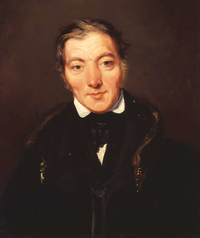
Robert Own, aged about 50 (Wiki Commons)
In 1816 Owen also established the first nursery school in Britain. That’s probably one reason why the bride at the wedding—the daughter of one of my cousins--chose this site. She is a former nursery school teacher who now assesses student teachers.
The children of Owen’s workers entered the schools he provided when they were as young as 18 months, and they continued their education until they were ten or (if their parents could afford to keep them out of the factory) until they were twelve.  For some reason Owen believed especially in music and dance for children. He also opposed corporal punishment of children. He also established an adult education institute for his workers.    

Compared to the British policy toward the poor at the time, Owen was a radical reformer. Nor did he confine his efforts to the cotton mill he owned.  He lectured on social reform well into the nineteenth century, and he also helped establish some of the first trade unions in Britain. My guess is he probably had far more influence on British social thought than Karl Marx and Friedrich Engels, two German-speakers who would not have been integrated into British society as Owen was.

As it happens, when I visited New Lanark I was also reading Alison Light’s book, Common People (Penguin 2014).  Light is a British social historian who decided to trace four lines of her ancestry, through all four of her grandparents. There weren’t many records of them, as they were indeed common folk, not the aristocrats fictionalized in Downton Abbey or self-indulgent artists like the Bloomsbury crowd that we often take as representative of British history.

 Light was born in 1955. One of her great-grandmothers spent the first eight years of her life in a workhouse and died in an asylum for the “insane.” Workhouses were appalling institutions where the poor were warehoused, given minimal if any food, and denied education, fresh air, or any form of recreation. Families were also separated. The idea was to make life so wretched for the poor that they would leave the workhouse, thus not being a charge upon the parish.

Some of Light’s ancestors worked in the eighteenth-century needle trade, manufacturing needles in their homes, risking blindness from poor lighting or shards of metal flying into their eyes. Many others led peripatetic lives, travelling all over Britain in search of work, enduring periods of unemployment and sickness without any assistance from their rulers. Light’s own father, born in the 1920s, had to leave school at 13 to go to work, even though he wanted to stay.

Alison Light (AlisonLight.org)
Light makes clear that life for common British people was extremely difficult. Only after WWII did it become possible for people like her, from common families, to enter university. Indeed, only after WWII was any serious effort made at social reform, despite the earlier existence of trade unions and the Labour party.  

Many of the more ideological students of international human rights still contend that “economic” human rights were introduced by the Soviet Bloc and by less-developed countries, while “the West,” so-called, focused only on civil and political rights. Reformers like Robert Owen in Britain (and briefly in America, at a failed social colony called New Harmony that he set up in Indiana in 1925) put the lie to this still common perception. It is true that the United States persecuted and deported many of its social reformers in the late nineteenth and early twentieth centuries, so that it does not have a viable left-wing, social democratic political alternative today. But social democracy and utopian socialism have a long history in most Western countries.

Those whose ideological predispositions make them despise “the West” as full of colonizers and exploiters would do well to read Light’s history of her own family to find out what life was like for most British people. They should also be more aware of reformers like Owen.